Gold Flakes Won't Save You: Where American Diners Finally Draw the Line on Luxury Burgers
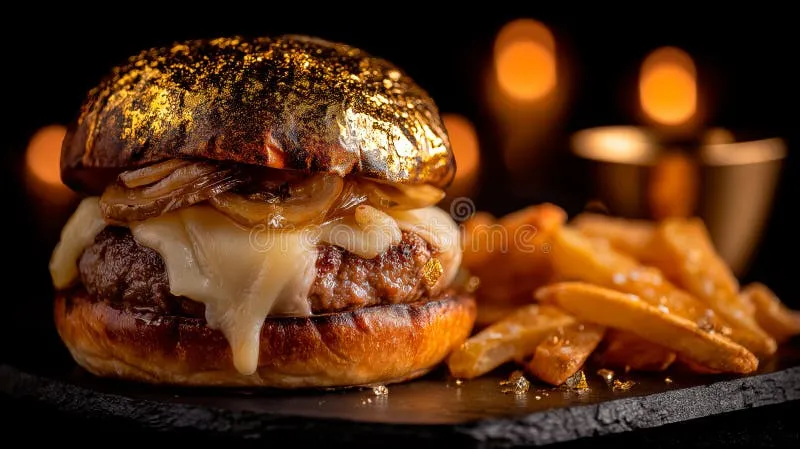
Photo: gourmet burger gold leaf luxury restaurant fancy plating, via thumbs.dreamstime.com
There's a photo that circulates every few months on food Instagram: a burger stacked so tall it needs a structural engineer, dusted with actual gold leaf, priced at $77, served at some Miami hotspot with a velvet rope outside. The comments are always the same. Half the people tag a friend with "we HAVE to try this." The other half type some version of "it's a HAMBURGER."
Both camps are right, and that tension is exactly where the luxury burger trend lives right now — and where it's starting to crack.
The Gold Rush Was Real
Let's give the trend its flowers first. The gourmet burger movement of the last fifteen years genuinely improved the American plate. It pushed restaurants to grind their own chuck, toast brioche in beef fat, source cheddar from actual Wisconsin dairies instead of a processing plant. The burger got taken seriously, and most of us are eating better because of it.
Then the arms race kicked in. If a $12 burger is good, a $24 burger with wagyu must be better. If truffle makes it fancy, gold leaf makes it content-worthy. Somewhere in that escalation, the burger stopped being food and started being a prop.
And here's the thing American diners noticed, even if they couldn't articulate it: none of those additions made the burger taste better. Gold leaf is flavorless. A dry-aged wagyu patty can absolutely be delicious, but a well-seared blend of chuck and brisket from a good butcher hangs right with it. The extras were never about the palate. They were about the price tag.
Where the Line Actually Is
Ask around — in restaurant industry surveys, in the replies under any viral $50 burger post — and a pattern emerges. The psychological ceiling for most American burger buyers sits somewhere between $18 and $25. Below that, a burger can be a splurge. Above it, the burger has to justify itself against an entire entrée category, and it usually loses.
It's not that people can't afford $50 for a patty. It's a value-perception problem, and it's brutally rational. A diner at a steakhouse understands paying $60 for a ribeye — they can see the cut, they know what it costs by the pound. A burger obliterates that transparency. Grind it, and a $30 steak becomes a $6 patty. The customer knows this. They might not know the math exactly, but they feel it. Every burger over roughly $25 triggers the same internal question: what am I actually paying for here?
The honest answer is usually rent, labor, and a chef's reputation. Which are real things! But they're hard to taste.
What the Smart Money Is Doing
The most interesting movement right now isn't at the top — it's the middle. A wave of fast-casual and neighborhood spots have figured out that the gourmet revolution works best when you keep the technique and drop the theater.
Think smash patties with properly aged cheddar, house pickles, sauces made in-house that morning, buns from a local bakery. Priced at $14 to $18. No gold. No truffle oil drizzled by a chef in a video. Just a burger built by people who care, sold at a number that lets you come back next week.
Places like this are quietly winning. Their customers aren't posting the burger — they're eating it, regularly, and telling a friend the old-fashioned way. Repeat business is the metric that actually keeps a restaurant alive, and the $50 burger was never built for repeat anything. Nobody's weekly habit is a gold-flaked novelty. That's a once-per-lifetime purchase.
The Comeback of the Humble Classic
There's also a backlash brewing that the luxury set should pay attention to. Diners are increasingly vocal about the plain cheeseburger done perfectly — the In-N-Out school of thought, the Midwestern tavern burger, the smash burger from a gas station in rural Texas that outperforms any $50 experiment you'll find in Manhattan.
The lesson underneath all of it: the burger's whole identity is accessibility. It's the dish of drive-ins, diners, backyard grills, and 2 a.m. cravings. Push it too far upmarket and it stops being a burger. It becomes a small steak with a bun, and the market for that turns out to be pretty small.
So here's our take at Burger 51: the future of the gourmet burger isn't more expensive. It's more honest. Better beef, handled well. Cheese that melts right. A bun that holds. A price that says "see you Thursday."
The gold leaf was never the point. It was never even the flavor. The point was always the patty — and the patty, thankfully, doesn't need a bodyguard.